Math Review Week 5
Highlights of what I (re)learned in week #5 of my math studies. Shorter week due to traveling.
Position, Velocity, and Acceleration
Suppose a car's position (in meters) at time \(t\) (in seconds) is
Derivatives describe how these quantities change. Velocity is the derivative of position, and acceleration is the derivative of velocity:
Antiderivatives let us work backward. Integrating acceleration gives velocity, while integrating velocity gives position:
The constant of integration is determined by the initial conditions, such as the car's initial velocity and position.
In short, differentiation takes us from position to velocity to acceleration; integration takes us in the reverse direction.
Finding Volume Using the Disc Method
Suppose we rotate the parabola \(y=x^2\) around the \(y\)-axis on the interval \(y\in [0,4]\) . The resulting solid is a paraboloid.
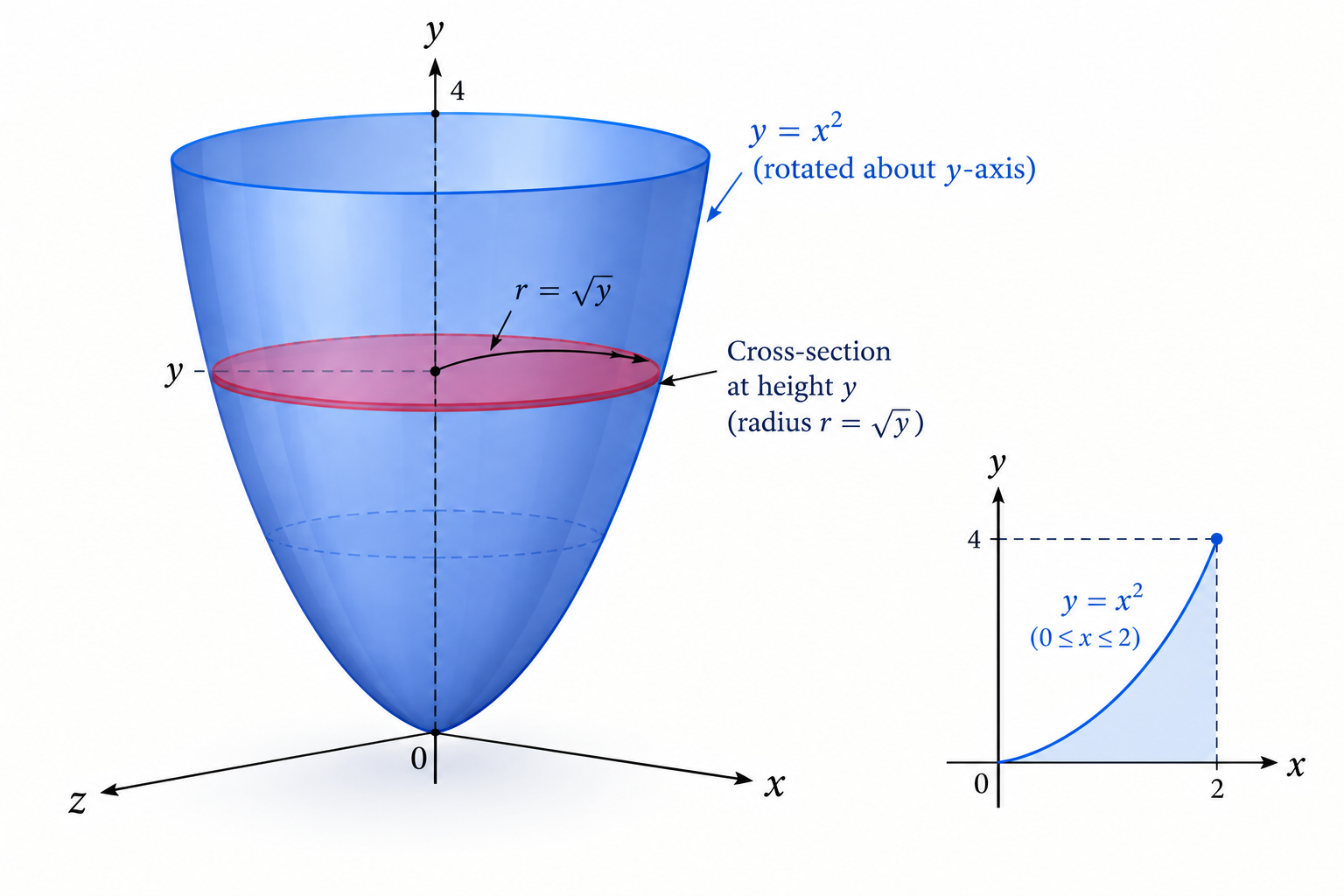
To use the disc method, we express \(x\) in terms of \(y\):
At each height \(y\), a cross-section perpendicular to the \(y\)-axis is a circle with radius \(r(y)=\sqrt{y}\). Its area is
Since \(y\) ranges from \(0\) to \(4\), the volume is
Evaluating the integral gives
The solid has a volume of (\(8\pi\)) cubic units.
The key idea behind the disc method is to integrate the areas of infinitely many thin circular cross-sections to obtain the volume of the entire solid. In general, when rotating \(x=f(y)\) around the \(y\)-axis,
Finding Volume Using the Washer Method
The washer method is useful when rotating the region between two curves around an axis, creating a solid with a hole through its center.
Suppose we rotate the region between \(y=x\) and \(y=x^2\) on the interval \([0,1]\) around the \(x\)-axis. Each cross-section is a washer, with outer radius \(R(x)=x\) and inner radius \(r(x)=x^2\).
The area of a washer is the area of the outer circle minus the area of the inner circle:
Substituting the functions, we obtain the volume integral:
Evaluating the integral gives
The solid has a volume of (\(\frac{2\pi}{15}\)) cubic units.
The key idea is to subtract the inner circle's area from the outer circle's area before integrating. In general, the washer method uses