Math Review Week 6
Highlights of what I (re)learned in week #6 of my math studies.
Arc Length
The formula for computing the arc length of a curve from a to b is:
or
Parametric Equations
Given
\(x = 2\sin(1+3t)\) and \(y = 2t^3\)
To find \(\frac{dy}{dx}\) when \(t=-\frac{1}{3}\), use the formula for parametric equations:
Step 1: Find the derivatives with respect to \(t\).
Using the chain rule,
Step 2: Calculate \(\frac{dy}{dx}\).
Substitute the derivatives into the formula:
Step 3: Evaluate at \(t=-\frac{1}{3}\).
Simplify:
Therefore, the final answer is
Parametric Curve Arc Length
Given the vector valued function:
\(\vec{r}(t) = x(t)\hat{i} + y(t)\hat{j}\)
The derivative is:
\(\vec{r}^{\,\prime}(t) = x'(t)\hat{i} + y'(t)\hat{j}\)
Polar Coordinates
\(x=r\cdot cos(\theta)\) and \(y=r\cdot sin(\theta)\)
Given
\(r=sin(2\theta)\)
Then
\(x=sin(2\theta)\cdot cos(\theta)\) and \(y=sin(2\theta)\cdot sin(\theta)\)
Area Bounded By Polar Curve
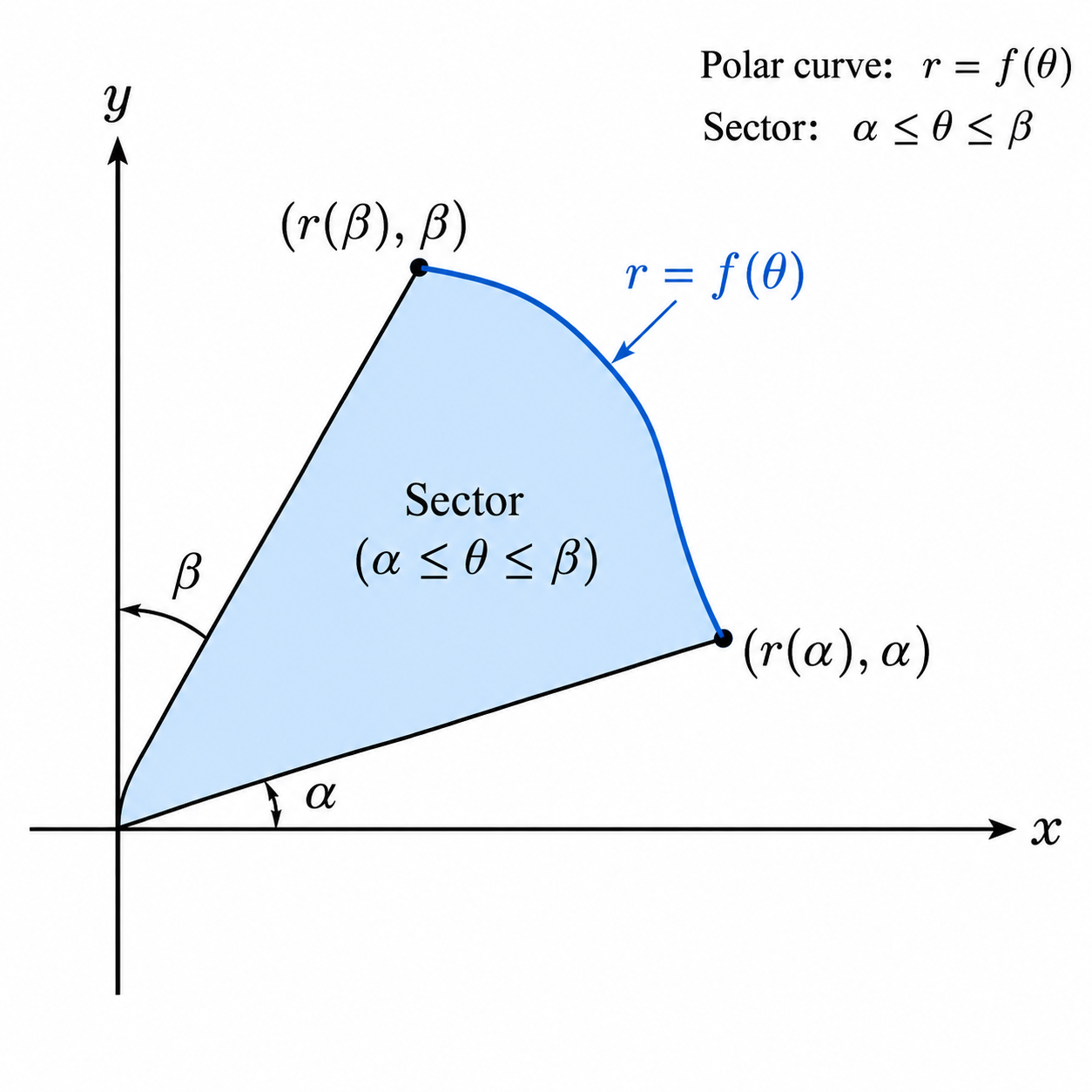
The area of a sector of angle \(\theta\) of a circle is \(\pi\cdot r^2\cdot \frac{\theta}{2\pi}\) or \(\frac{r^2 \theta}{2}\)
So the area from angle \(\alpha\) to \(\beta\) of a polar curve is:
\(\int_\alpha^\beta \frac{1}{2}(r(\theta))^2 \; d\theta\)