Math Review Week 7
Highlights of what I (re)learned in week #7 of my math studies.
- Area bounded by two polar curves
- Infinite sequences and series
Area Bounded By Two Polar Curves
Let \(R\) be the region inside the polar curve \(r = 3\cos\theta\) and outside the polar curve \(r = 1+\cos\theta\).
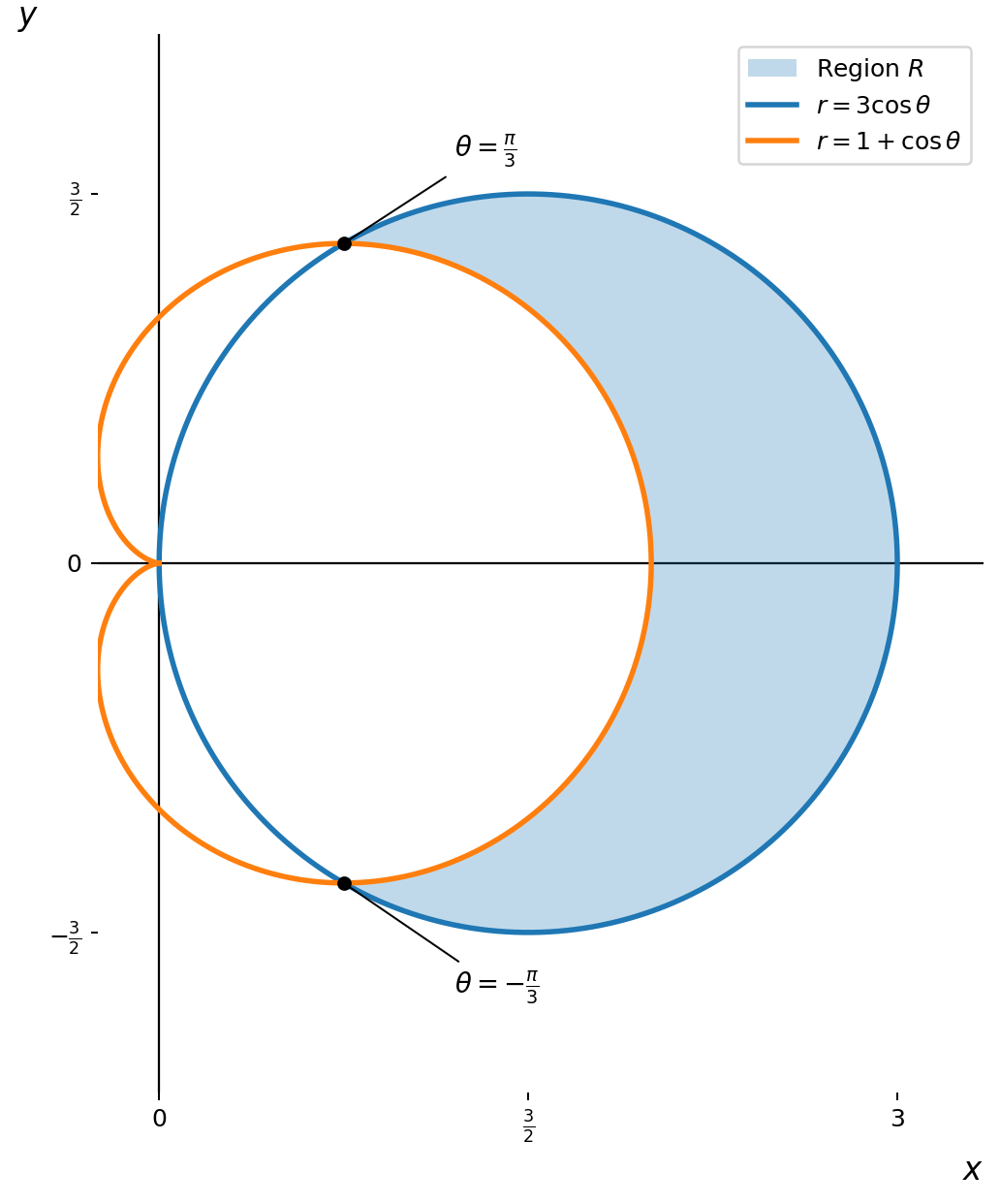
Finding the Intersection Angles
To find where the curves intersect, set their equations equal:
Solving for \(\theta\),
and therefore
The intersection angles in the interval \([-\pi,\pi]\) are
The corresponding intersection points in Cartesian coordinates are
Compute the area via integration
Infinite sequences and series
Geometric Series
Divergence Test
The Integral Test
If \(f(x)\) positive, continuous and decreasing on \([k, \infty)\):
(1) if \(\int_{k}^{\infty} f(x)\; dx\) is convergent, then \(\sum_{n=k}^{\infty} f(n)\) is also convergent.
(2) if \(\int_{k}^{\infty} f(x)\; dx\) is divergent, then \(\sum_{n=k}^{\infty} f(n)\) is also divergent.
Harmonic Series (special case of P-Series)
Harmonic Series = \(\sum_{n=1}^{\infty} \frac{1}{n} =\) \(1 + \frac{1}{2} + \frac{1}{3} + \frac{1}{4} + \cdots\) diverges
P-Series
Direct Comparison Test
(1) If B (larger) converges, then A (smaller) also converges.
(2) If A (smaller) diverges, then B (larger) also diverges.
Limit Comparison Test
Alternating Series Test
Ratio Test
If \(L < 1\), the series converges
If \(L > 1\), the series diverges
If \(L = 1\), the test is inconclusive
Conditional and Absolute Convergence
If a series converges, but its absolute value does not converge, we say the series converges conditionally.
If a series converges, and its absolute value also converges, we say it converges absolutely.