Math Review Week 9
Highlights of what I (re)learned in week #9 of my math studies.
- Radius and interval of convergence of power series
- Maclaurin Series for cos(x), sin(x) and \(e^x\)
- Euler's Formula
- Finished Phase 1 - Single Variable Calculus!
Radius and interval of convergence of power series
Power Series
Geometric Series
Geometric series converges if \(|x| < 1\) The interval of convergence, or radius of convergence, is \(-1 < x < 1\)
Example: What is the interval of convergence for:
Use the Ratio Test to find the interval of convergence is \(-5 < x < 5\); however, we also need to test the inconclusive cases where \(x = -5\) and \(x = 5\).
Case 1: \(x = 5\)
Case 2: \(x = -5\)
So, our interval includes \(x = -5\), and the interval of convergence is \(-5 \le x < 5\)
Maclaurin Series for cos(x), sin(x) and \(e^x\)
Euler's Formula
or
grouping real and imaginary gives:
or
What if \(x = \pi\) ? You get Euler's Identity (Richard Feynman loved this expression - it links five of the most important constants in mathematics: 0, 1, e, i, and \(\pi\)):
Finished Phase 1 - Single Variable Calculus
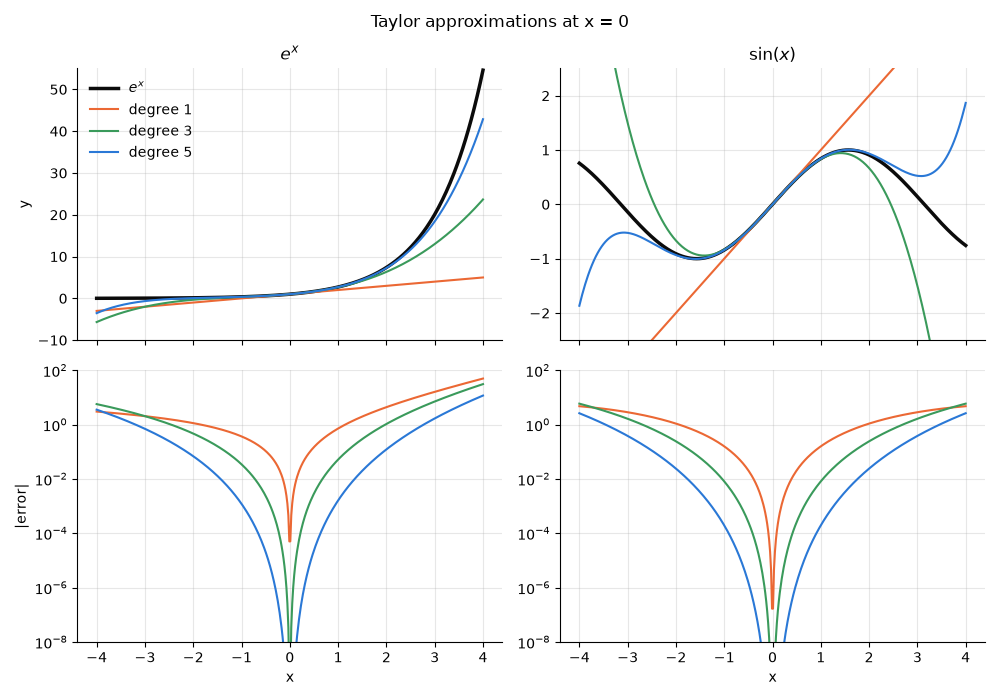
Here is a chart showing Taylor series approximation for \(e^x\) and \(sin(x)\) with error charts based on the degree of the polynomial approximation:
On to Phase 2 - Linear Algebra!